🔓 Unlock the Full Workshop
Enter your email to access all 21 sources of hidden cash in your budget. Free, no strings attached.
Your info is secure and never shared.
Key Concepts to Master
Before we dive into the 21 sources, understand these foundational principles that make wealth building possible.
📍 Financial Independence Number (FIN)
The amount needed in savings/investments to generate income that replaces your paycheck. Retirement is no longer an age — it's a number.
Example: $90K/year income need = ~$1.5M accumulated (using 4% rule)
🛡️ Playing Defense vs. Offense
Defense: Paying down debt · Offense: Investing money
You need both to win.
🎭 The Oxygen Mask Principle
"Put your oxygen mask on first before helping others." Secure YOUR finances first before funding kids' accounts or college. If you sacrifice your future for kids' present, you BOTH lose.
Tax Refund Optimization
⚠️ The Problem
Average refund $3,000-$4,000 = 0% interest loan to government. You're giving Uncle Sam an interest-free loan all year.
✅ The Strategy
- Adjust W-4 allowances to get refund near $0
- 1 allowance ≈ $600/year ($50/month)
- 6 allowances = $300/month back in your paycheck
401(k) Match Optimization
⚠️ The Problem
Overfunding 401(k) beyond company match. You're putting too much in a high-fee, restrictive account when better options exist.
✅ The Strategy
- Contribute ONLY up to the match (100% return day one)
- Redirect excess to: Roth IRA, debt payoff, emergency fund, or life insurance
- 401(k)s have higher fees and more restrictions than IRAs
Life Insurance Restructuring
⚠️ The Problem
Whole life/universal life policies are expensive and inefficient. They benefit the insurance company more than you.
| Whole Life | Term + Invest Difference |
|---|---|
| $295/month | $78/month (30-year term) |
| $150K coverage | $300K coverage |
| 1-3% returns | Market returns in Roth IRA |
| Borrow at 5-8% | No restrictions |
💡 Visual Comparison: Same Monthly Cost, Very Different Results
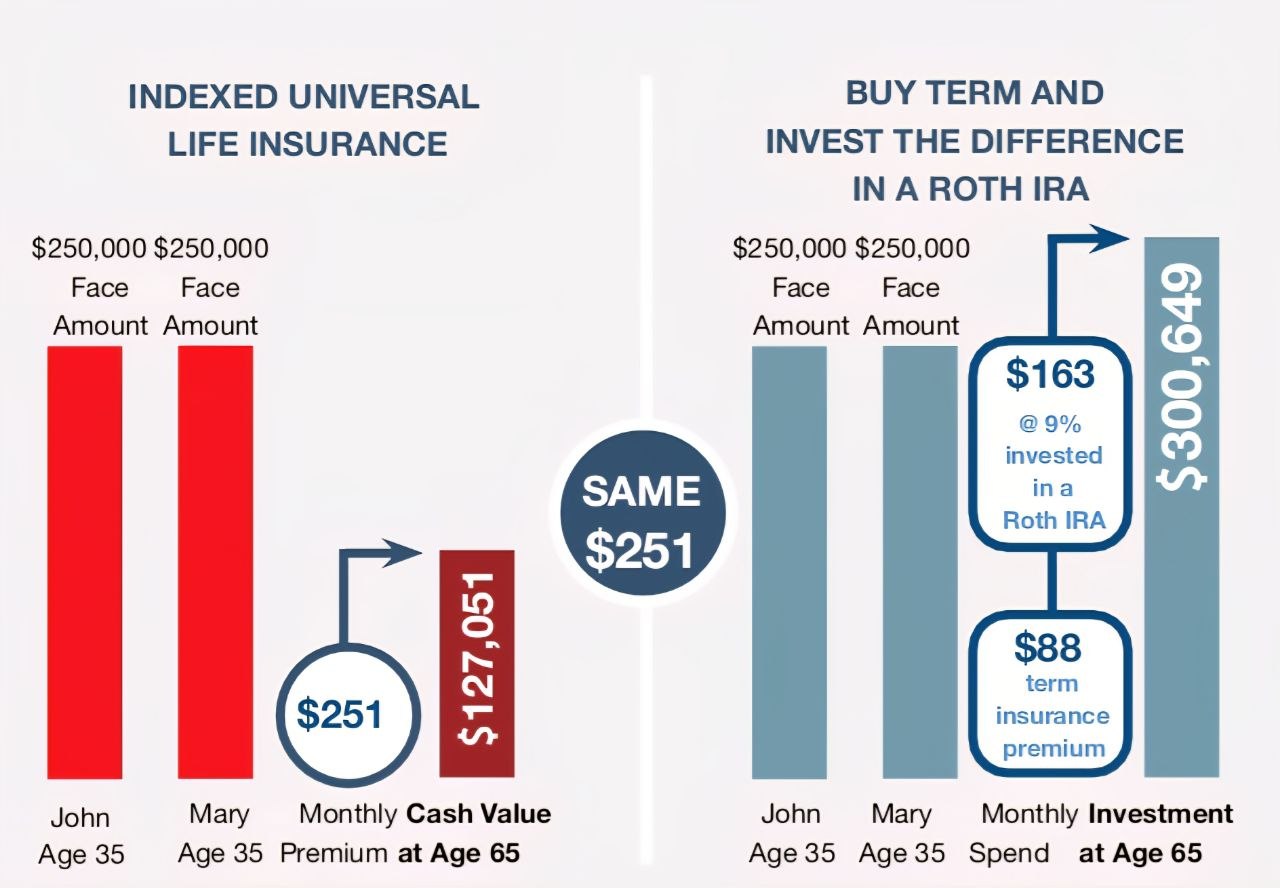
At age 65: Cash value policy = $127K vs Term + Roth = $300K+
Auto & Home Insurance Shopping
⚠️ The Problem
Rates change; loyalty costs money. Auto insurance has had 243% inflation since 2020 — highest of any industry.
✅ The Strategy
- Shop every 2-3 years through A-rated broker
- Bundle when beneficial (but verify it's actually cheaper)
- Don't auto-renew without comparing
2/3 of people save money by shopping
Savings Account Optimization
⚠️ The Problem
0.01% interest on $20K = pennies. It's taxed, and it loses to inflation. Your money is sleeping when it should be working.
✅ The Strategy
- Move to tax-free mutual funds generating 5% dividends
- $20K at 5% = $1,000/year tax-free (vs. $400 taxable at bank)
- Use dividends to pay life insurance premium
Debt Negotiation Strategy
⚠️ The Problem
High-interest credit card debt draining your monthly cash flow. Minimum payments barely touch principal.
✅ The Strategy
- Save $1,000 emergency fund first (don't skip this)
- Put cards on freeze (cut them up if needed)
- Negotiate settlements or payment plans
- Expect credit score hit for 2-3 years (temporary)
Debt Consolidation via HELOC
⚠️ The Problem
Credit card debt at 24% APR is a wealth destroyer. The interest compounds against you every month.
✅ The Strategy
- Use home equity to pay off high-interest debt
- $45K credit cards at 24% → HELOC at 6.5%
- Interest becomes tax-deductible
- One payment vs. many
Frees up $1,390/month for investing
Mortgage Escrow Review
⚠️ The Problem
Banks often over-escrow by $5K+. They're holding YOUR money interest-free.
✅ The Strategy
- Call mortgage provider for escrow analysis
- Request refund or reduction if over-funded
- Review annually (taxes and insurance change)
PMI Elimination
⚠️ The Problem
Paying Private Mortgage Insurance when you have 20%+ equity. Home values have risen significantly since 2018-2020.
✅ The Strategy
- 20%+ equity = PMI elimination
- May require reappraisal (worth the cost)
- Check your loan servicer's requirements
Debt Stacking/Snowball Method
⚠️ The Problem
Random payments spread across debts. Credit cards reamortize monthly = most payment goes to interest, trapping you in debt.
✅ The Strategy
- Minimum payments on all debts except ONE
- All extra money on highest-interest debt until eliminated
- Roll that payment to next debt (snowball effect)
- Use software to calculate optimal order
If invested at 12% for 15 years = $1.335M
The Oxygen Mask Principle
⚠️ The Problem
Parents fund kids' accounts/college while neglecting own debt and retirement. You're sacrificing your future for their present.
✅ The Strategy
- Secure YOUR financial independence FIRST
- Kids have more time to compound; you don't
- You can borrow for college — CANNOT borrow for retirement
- Be an example through financial stewardship
Avoid Lifestyle/Commitment Creep
⚠️ The Problem
Pay raises lead to spending increases, neglecting financial planning. "Keeping up with the Joneses" — who are often financing life on debt.
✅ The Strategy
- Read "The Millionaire Next Door" — build wealth privately, secretly
- Freedom and stress-free life > appearances
- Break the generational curse in 24 months, not decades
- Delay gratification — the key to building wealth
Budget Apps & Expense Tracking
⚠️ The Problem
Unconscious spending leaks. Subscriptions you forgot about. Duplicate services. Money bleeding out unnoticed.
✅ The Strategy
- Use Rocket Money or similar app ($6/month)
- Average 5-10% spending reduction in first year
- They cancel unwanted subscriptions for you
Gamify Your Savings
⚠️ The Problem
Saving feels boring and punishing. No immediate reward, so motivation fades quickly.
✅ The Strategy
- Turn it into a 90-day challenge/game
- Set a specific savings goal for 90 days
- Use physical cash in a box (tactile motivation)
- Or open money market/mutual fund and race to $10K
- Create visual progress tracking
Retirement Plan Tax Savings
⚠️ The Problem
Paying taxes you could defer or reduce. Not maximizing tax-advantaged accounts.
✅ The Strategy
- $7,500/year per person in traditional IRA (2026 limit)
- $15,000/year for married couple
- Tax savings: ~$4,500/year (30% bracket)
Real cost: $10,600 out-of-pocket for $15,000 account
Find Old/Neglected Retirement Accounts
⚠️ The Problem
Forgotten 401(k)s from old jobs not growing properly. When companies change providers, accounts get moved to money markets (0% growth).
✅ The Strategy
- Contact former employers' HR
- Locate all old 401(k) accounts
- Roll over to IRA or current 401(k) with investment choices
Consolidate Multiple IRAs
⚠️ The Problem
4-5 IRAs thinking you're diversifying, but really just paying 4-5 administrative fees. One IRA can be perfectly diversified.
✅ The Strategy
- Consolidate to one IRA
- Eliminate duplicate fees
- Simpler management, same diversification
In-Service Distributions (Age 59.5+)
⚠️ The Problem
Many don't realize they can access 401(k) money penalty-free at 59.5+ while still working.
✅ The Strategy
- Access 401(k) penalty-free at 59.5+ while still employed
- Pay off high-interest debt
- Roll to IRA for better growth/protection
- Access better investment options outside 401(k)
Optimize Non-Retirement Assets
⚠️ The Problem
Stock options sitting in one company stock (20-40% of net worth). Brokerage accounts with tax inefficiencies. Day trading destroying wealth.
✅ The Strategy
- Don't let 20-40% of net worth sit in one company stock
- Exercise stock options before retirement to avoid tax bracket issues
- Stop day trading — even breaking even costs years of compounding
💡 Understanding Tax Brackets & Long-Term Capital Gains
Tax thresholds change regularly. Check the current IRS tax-bracket guidance before making a tax decision.
Education Money: Get It Into 529 Plans
⚠️ The Problem
College savings sitting in the wrong accounts: whole life policies, CDs, money markets, high-yield savings, or regular index funds. These are tax-inefficient for education.
✅ The Strategy
- Move education funds to 529 college savings plans
- Tax-free growth when used for qualified education expenses
- Give every dollar a job — assign it to the appropriate account with the right tax code
- New rules: unused 529 funds can roll into Roth IRA (up to $35K lifetime)
❌ Whole life policies (low returns, fees)
❌ CDs & Money Markets (taxed, barely beating inflation)
❌ Regular index funds (taxed on gains)
✅ 529 Plans = Tax-free growth for education
Home-Based Business
⚠️ The Problem
Part-time W-2 job = higher tax bracket on lower wages. Trading time for money with no wealth building.
| Part-Time Job | Home-Based Business |
|---|---|
| W-2 income | 1099 income |
| 22% tax bracket | First $5-20K could be tax-free |
| No deductions | Business expense deductions |
| No wealth building | Tax-advantaged wealth building |
Potential savings: $60,000/year in taxes
Your Next Step
You've discovered 21 ways to find hidden cash. The question is: what percentage of your income is passive? What comes in whether you work or not?
Schedule Your Review