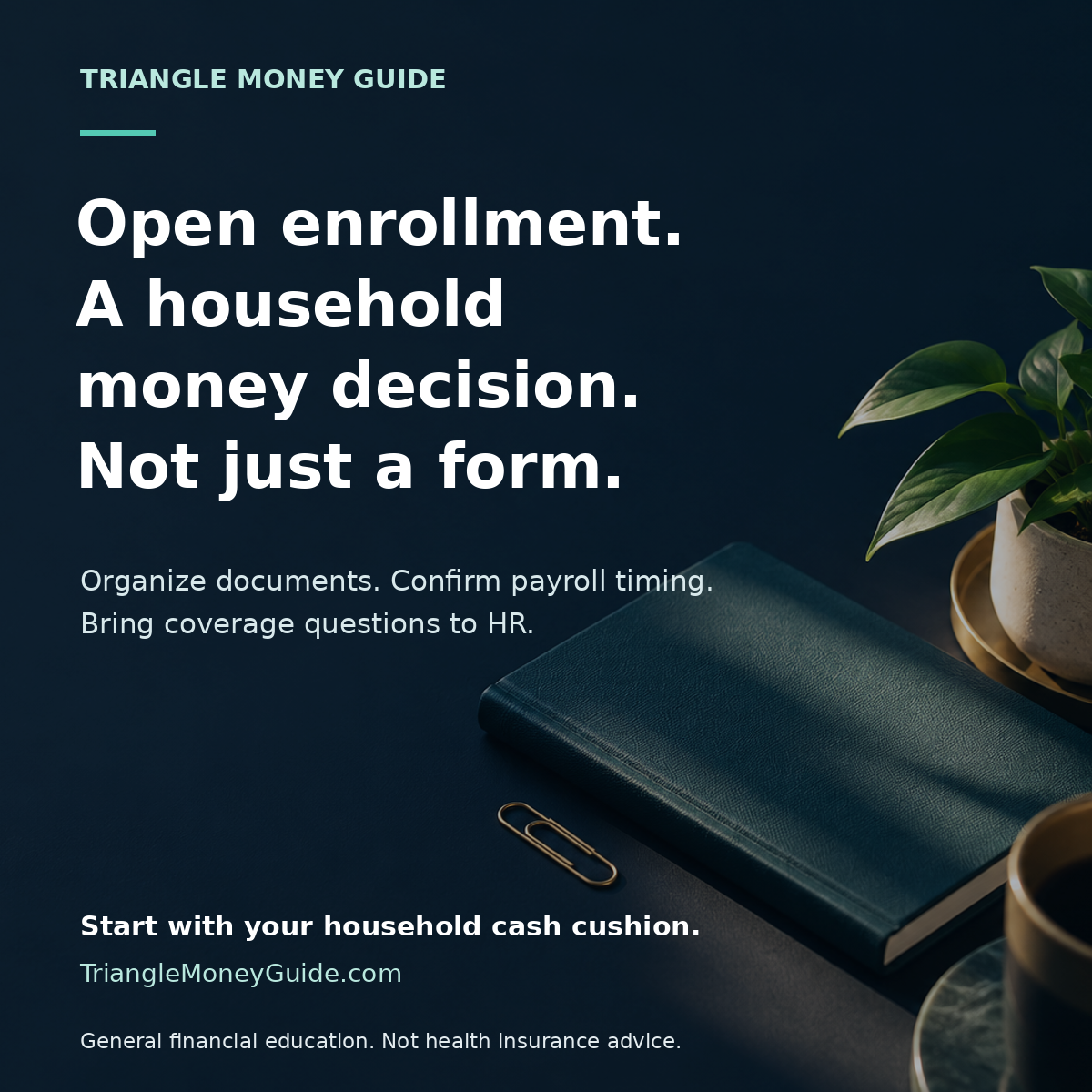
The email arrives between work messages and a reminder about school pickup. Open enrollment. Another portal. Another deadline to put somewhere you will actually remember.
For a household in Raleigh, Durham, or Chapel Hill, the useful first step is not guessing which coverage to choose. It is making room for a money conversation: What documents do we need? When could payroll deductions change? What questions need a professional answer?
This is general household financial education, not health insurance advice. Coverage, eligibility, and enrollment questions belong with your employer's HR team, plan administrator, or an appropriately licensed health insurance professional. This checklist does not evaluate or recommend a plan.
1. Make one household folder before opening more tabs
Gather the employer's current notices, payroll information, and the contact details for the people who can answer benefits questions. Keep the relevant year on each document. Last year's email can stay in the archive rather than masquerading as this year's instructions.
Ask HR or the plan administrator where to get the current Summary of Benefits and Coverage and related documents. The Department of Labor maintains SBC templates and a Uniform Glossary as reference materials.[1] You do not need to interpret coverage yourself to collect the right paperwork.
Put a simple note at the top of the folder: “Questions still waiting for answers.” That is more useful than assuming a confusing term means what it sounds like. Keep medical and employment records private; this is a household file, not something to post in a comment thread.
2. Put the employer's dates on your own calendar
Ask the employer or plan administrator to confirm the applicable deadline, any required action, and where to find written instructions. Do not borrow a coworker's dates from another employer or rely on a general social-media reminder.
For the budget, ask payroll when any confirmed deduction changes would first appear. Save the response beside your bill calendar. If two adults have separate employers, keep separate notes and contacts rather than blending the notices together.
The goal here is organization, not an enrollment recommendation. Let the appropriate benefits professional explain what the instructions mean for your situation.
3. Turn confirmed payroll figures into budget numbers
A per-paycheck amount and a monthly budget amount are not interchangeable. Use the deduction amount and number of affected paychecks confirmed by payroll, then translate them into the same time period as your household spending plan.
Hypothetical arithmetic only: a $120 premium deduction taken from each of 26 paychecks totals $3,120 over a full year. Dividing by 12 gives a $260 monthly average. That is a budgeting illustration, not a quote, coverage estimate, or recommendation.
The average helps with annual planning. The actual deduction schedule helps with the checking-account calendar. Ask payroll about the effect on take-home pay rather than assuming a deduction change translates dollar for dollar into spendable income.
If you start with net pay in your budget, do not subtract deductions already taken from that paycheck a second time. Keep them on a reference line if you want visibility without double counting.
4. Keep recurring deductions separate from possible bills
Use one line for confirmed recurring payroll deductions and another for cash you are setting aside for possible out-of-pocket expenses. Paying premiums is not the same budgeting task as having cash available for a bill.
Do not use the payroll total as a forecast of all medical spending. Ask the plan administrator or appropriately licensed health insurance professional to explain any coverage terms, cost-sharing amounts, exclusions, or limits you need clarified. This worksheet does not interpret those provisions or calculate your maximum liability.
Once you have reliable information, the household task is deciding how to organize your cash calendar. Write down what is confirmed, what is only a budgeting placeholder, and what still needs an answer. A blank labeled “not confirmed” is better than a confident guess.
5. Give savings a job without counting the same dollars twice
The CFPB describes an emergency fund as a cash reserve for unplanned expenses and says the appropriate amount depends on your situation.[2] That is a useful starting point, not a promise that one savings target covers every possible expense.
For predictable expenses in your own spending plan, consider a separate budget category. Keep the emergency cushion visible too. If the same $600 appears under both categories, you still have $600, not two separate reserves.
A second hypothetical example: building a $600 cash buffer over 12 months means setting aside $50 a month. That is simply savings arithmetic, not a recommended medical reserve. Choose a general savings goal that fits your household budget, and revisit it as circumstances change.
A short checklist for tonight
- Collect the current employer documents and the correct benefits contact.
- List the dates and payroll timing you need confirmed.
- Write coverage and eligibility questions for the appropriate benefits professional.
- Update your budget using confirmed figures, without double counting deductions.
- Label planned savings separately from emergency savings.
You do not have to solve every question at the kitchen table tonight. Leave with a cleaner folder, a clearer calendar, and a written list for the people qualified to answer the rest.
Educational disclosure: General financial education only, not health insurance, medical, tax, or legal advice. No product or plan recommendation is made. Direct coverage, eligibility, and enrollment questions to HR, your plan administrator, or an appropriately licensed health insurance professional.