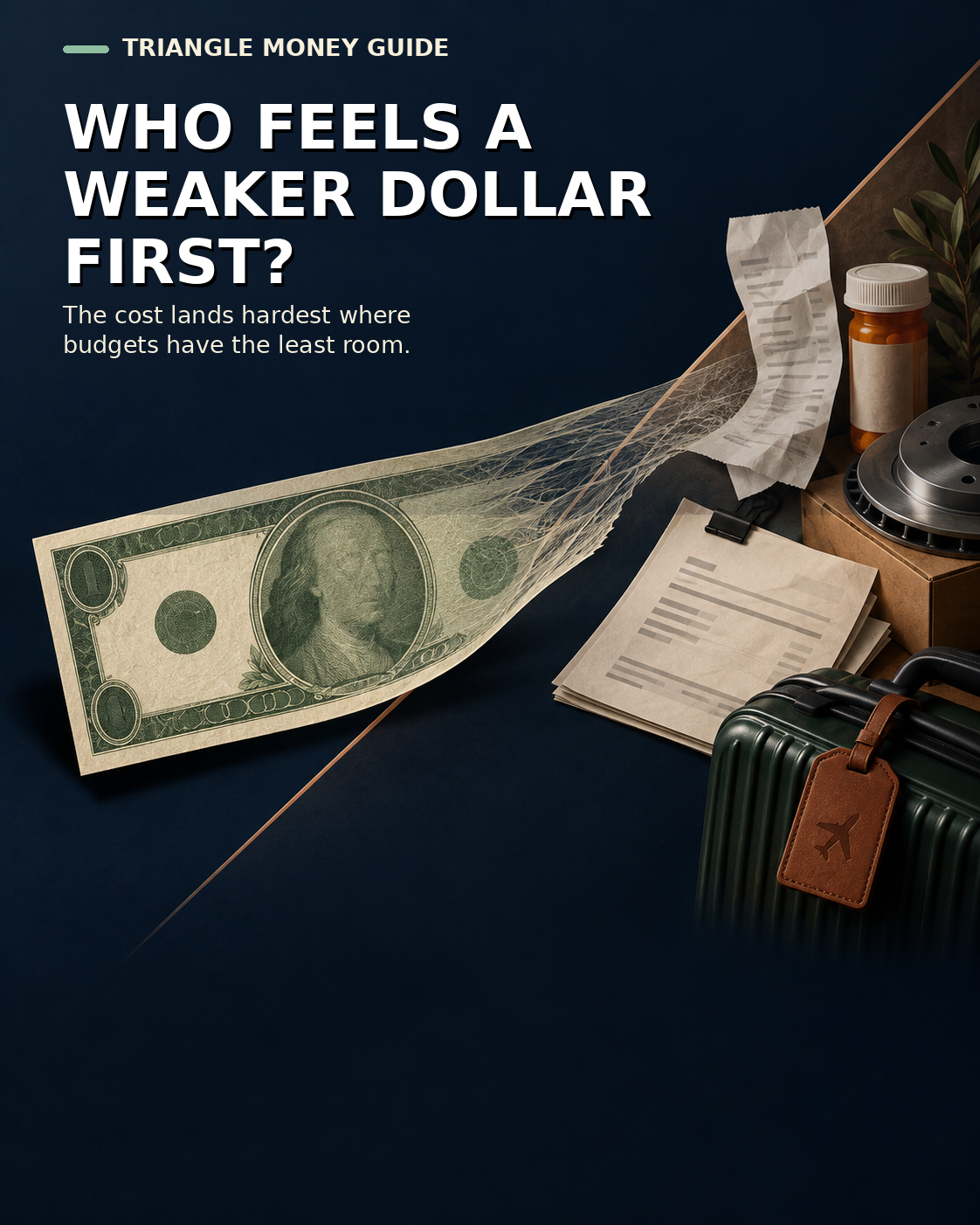
When people hear that the U.S. dollar is weakening, the conversation often turns into a scoreboard. Exporters might win. International travelers might lose. Markets move, economists argue, and most families are left wondering whether any of it will actually show up in their checking account.
The better question is not simply whether a weaker dollar is good or bad.
It is: Who has to absorb the cost, and who has enough room to handle it?
That is where the answer becomes less abstract. A weaker dollar does not hurt everyone equally. It tends to create the most stress for people who buy imported goods or foreign-currency services and already have very little flexibility in their budget.
First, what does “a weaker dollar” mean?
A weaker dollar means one U.S. dollar buys less of another currency than it did before. If an item costs 100 euros and the dollar weakens against the euro, an American buyer generally needs more dollars to pay the same 100-euro price.
The Federal Reserve's broad dollar index was 118.0732 on September 4, 2026. That was about 1.28% below its first 2026 reading and 2.23% below the reading from one year earlier.
That is a meaningful movement, but it is not evidence that the dollar is collapsing. It also does not mean every household price rises 2.23%. Currency changes move through contracts, inventories, shipping costs, supplier margins, tariffs, and retailer decisions before they reach a shelf.
The pain is uneven. Here is who is usually most exposed.
1. Households that already have no room left
If a family earns enough to save every month, a slightly more expensive appliance or car part may be annoying. If nearly every dollar is already committed to housing, food, transportation, insurance, and debt, the same increase can force a tradeoff.
That is why percentages do not tell the whole story. A small increase can be more damaging to a household with no monthly margin than a much larger increase is to a household with substantial savings.
The Federal Reserve's July 2026 Monetary Policy Report made a related point about food and energy: lower-income households are especially sensitive because those necessities take up a larger share of their spending. The report does not say dollar weakness caused all recent food and energy inflation. It does show why one more source of price pressure lands harder on families with less room to adjust.
2. Retirees and people living on relatively fixed income
Many retirees have income from Social Security, pensions, annuities, or planned portfolio withdrawals. Those income sources may be dependable, but they do not necessarily rise whenever a needed product becomes more expensive.
A retiree may be able to postpone an overseas vacation. It is harder to postpone replacing a failed refrigerator, repairing a car, or buying a medical device that contains imported components.
The problem is not that every retiree will suddenly face a currency-related emergency. It is that expenses can adjust faster than income does.
3. Families with unavoidable overseas expenses
International travel is one of the clearest places to see currency movement.
If your hotel, tuition bill, train ticket, or family expense is priced in euros, pounds, Canadian dollars, or yen, a weaker dollar means you may need more dollars to cover it. There is less cushioning between the exchange rate and the amount charged to your card.
This can affect:
- families with a child studying abroad;
- people supporting relatives in another country;
- workers traveling internationally;
- families who already paid for airfare but still owe for lodging and meals; and
- anyone planning a major foreign purchase.
The practical move is not to cancel every trip. It is to recheck the cost in dollars and leave room for movement instead of treating an old estimate as guaranteed.
4. Anyone forced to replace an import-heavy product
Electronics, appliances, furniture, vehicles, auto parts, apparel, and specialty goods can all contain imported value.
Again, this does not mean prices rise immediately or by the exact percentage the dollar fell. A retailer might have older inventory. A supplier might absorb part of the increase. Domestic labor and transportation can make up a large part of the final price.
But timing matters.
Someone casually considering a new television can wait. Someone whose work laptop died cannot. A family with a functioning car has options. A family waiting on an imported transmission part may not.
The people who suffer most are often not the people buying luxuries. They are the people making necessary purchases on someone else's timetable.
5. Small businesses that rely on imported inputs
A weaker dollar does not stop at the household front door.
A Triangle restaurant might rely on imported ingredients or equipment. A contractor might buy tools, fixtures, or components made abroad. A retailer may purchase finished inventory from an overseas supplier. A repair shop may need imported parts.
Large companies can sometimes hedge currency exposure, negotiate long contracts, or spread costs across a huge customer base. A small business may have none of those advantages.
When costs rise, the owner has three unpleasant choices:
- absorb the increase and accept a smaller margin;
- raise prices and risk losing customers; or
- cut spending somewhere else.
That third option is how currency pressure can eventually reach workers through slower hiring, fewer hours, smaller bonuses, or delayed investment. It is a possible chain of events, not an automatic one, but it shows why the burden can spread.
Why prices do not move one-for-one
The Bureau of Labor Statistics explains that currency depreciation generally raises import prices. Federal Reserve and U.S. International Trade Commission research also show that the pass-through to consumer prices is often incomplete.
A foreign manufacturer might accept a smaller profit margin to protect U.S. market share. A retailer might hold prices steady until new inventory arrives. A product's final price might include substantial U.S. wages, rent, marketing, and transportation that do not change directly with the exchange rate.
So if the dollar falls 5%, your total cost of living does not automatically rise 5%.
That is also why dramatic headlines are not a useful household plan. The exposure depends on what you actually buy.
Does anyone benefit from a weaker dollar?
Yes. A weaker dollar can help some U.S. exporters because their goods may become more affordable to foreign buyers. American tourism businesses may benefit if visiting the United States becomes cheaper for foreign travelers. U.S. companies with overseas revenue can sometimes report higher dollar-denominated earnings when foreign income is translated back.
Investors who already own unhedged international assets may also receive a currency boost in dollar terms, though market losses can easily outweigh it. That is not a reason to rebuild a portfolio around a currency forecast.
A weaker dollar creates winners and losers. The important household truth is that the winners tend to have financial tools, assets, or business exposure working in their favor. The people hurt most often experience it as another bill.
A five-minute dollar exposure check
You do not need to predict the foreign-exchange market. Ask five practical questions:
- Do I have a foreign trip, tuition payment, or cross-border family expense coming up? Reprice it in current dollars.
- Which appliance, vehicle, or electronic device might need replacement soon? Get a real quote before assuming the cost.
- Would a modest price increase force me to use a credit card? If yes, the emergency fund matters more than the currency forecast.
- Does my income adjust slowly while my essential costs can move quickly? Build extra room around the categories you cannot delay.
- If I own a business, which supplier quotes or contracts are exposed to foreign currency? Know where a cost change could reach your margin.
This exercise is not about panic-buying. Buying something early with high-interest debt can cost far more than any increase you hoped to avoid.
The Triangle household response
Most families in Raleigh, Durham, Cary, Apex, and Chapel Hill do not need a currency strategy. They need a resilience strategy.
That means:
- keeping a starter cash cushion;
- reducing high-interest debt;
- pricing upcoming major purchases;
- giving internationally priced expenses extra room; and
- avoiding major investment changes based on a single economic headline.
If an unexpected appliance, car repair, or travel expense would go straight onto a credit card, start with the Emergency Fund Calculator. It can help you turn a vague goal into a monthly target.
The bottom line
A weaker dollar does not punish every household equally.
The greatest burden tends to fall on people who cannot avoid the exposed expense and do not have enough margin to absorb it. That includes lower-income households, some retirees, families with foreign-currency obligations, people replacing imported products, and small businesses that depend on imported inputs.
You cannot control the dollar. You can identify where it touches your life, price the expenses that matter, and build enough margin that a currency headline does not become high-interest debt.
Sources
- Federal Reserve Economic Data: Nominal Broad U.S. Dollar Index
- Federal Reserve: Monetary Policy Report, July 2026
- Bureau of Labor Statistics: How currency appreciation can impact prices
- U.S. International Trade Commission: How Do Exchange Rates Affect Import Prices?
- Federal Reserve: Exchange Rate Pass-Through and Monetary Policy
This article is for educational purposes only and is not individualized investment, tax, or financial advice. Currency values, prices, and household circumstances can change.
Triangle Money Guide helps households in Raleigh, Durham, Cary, Apex, Chapel Hill, and surrounding communities make clearer money decisions. Schedule a free consultation to talk through your household plan.